
Launch of the Portuguese Circularity (CPC) Cluster
The launch of the Portuguese Circularity Cluster (CPC) on November 18th marked a significant moment for the national circular economy ecosystem, bringing together public entities, companies, research centers, and entrepreneurship support structures.
Portugal Entering the Circularity Era: The CPC's Impulse
The opening session, led by João Nunes, president of CECOLAB, and Aires Pereira, president of the Smart Waste Portugal Association (ASWP), emphasized the strategic importance of the cluster in strengthening the country's competitiveness in an increasingly demanding European context. Both stressed that Portugal needs to accelerate the circular transition and place its initiatives on the European radar, creating critical mass and paving the way for international cooperation.

Aires Pereira highlighted the crucial role of ASWP members and the organizations that make up the CPC, recalling that circularity is far from being just an environmental concept: it is an economic, industrial, and cultural transformation. With a national circularity rate still at 2.8%, well below the European average of 11%, he reinforced the urgency of increasing the lifespan of materials, fostering new business models, and actively involving industrial sectors. He also emphasized that the celebration of ASWP's tenth anniversary coincides with a new phase for the country, where the aim is to consolidate circular practices and bring the Portuguese economy closer to the targets set by the European Commission.

Following this, Octávio Borges, from the Entrepreneurship and Innovation department of IAPMEI, reinforced the role of clusters as drivers of competitiveness and internationalization. Referring to Portugal's industrial turnover exceeding €112 billion, he emphasized that collaboration between companies—especially large companies, SMEs, and startups—is crucial for achieving growth rates exceeding 35%. He further highlighted that the CPC (Portuguese Cluster Council) can function as a space for coordinating public policies, monitoring opportunities, sharing information on funding, and creating visibility for innovative initiatives. He stated that optimism should not be naive but based on the real capacity to grow through cooperation.

Subsequently, Luís Matias, coordinator of IIBT Pinhal Interior, drew attention to the need to strengthen territorial cohesion. He mentioned that many inland regions carry a feeling of abandonment, but highlighted exemplary cases such as BLC3 in Lagares da Beira, demonstrating that innovation is possible even in less favored territories. The CPC, he stated, can contribute to reducing asymmetries and bringing knowledge, investment, and industry closer together.

Alexandra Rodrigues, vice-president of CCDR Centro, added perspectives on fund management, highlighting that the cluster will play a decisive role in identifying and structuring funding opportunities for companies and startups developing solutions for the circular economy. She also reinforced the importance of collaboration with other European clusters and expressed the ambition to create an international fair dedicated to promoting circularity services and technologies, capable of positioning Portugal as a benchmark hub.

The formal presentation of the CPC, led by Filipa Figueiredo, executive director of the cluster, framed the strategic and operational vision of this initiative. It defined clear priorities: strengthening multi-sectoral collaboration, boosting joint projects, supporting the green digitalization of companies, and promoting a transition based on scientific evidence and robust metrics. Among the highlighted sectors, the bio-waste, textile, and construction sectors were particularly noteworthy. This introduction established the ideal context for the most anticipated moment of the event: Miguel Brandão's presentation.

Circularity: Between Intuition, Data, and Complexity
Professor Miguel Brandão 's keynote address from the Royal Institute of Technology (KTH) in Stockholm offered an in-depth and thought-provoking perspective on integrated systems assessment, highlighting the complexity of measuring sustainability. Starting with the evolution of global resource use over the last 50 years, he showed that the world is far from reaching a tipping point in reducing the exploitation of raw materials, and that fossil fuels continue to dominate the energy landscape. Despite the growth of renewables, global dependence remains high.

Brandão shared a set of counter-intuitive lessons derived from life cycle assessments (LCA), demonstrating that seemingly sustainable choices can, in certain contexts, generate greater impacts than conventional alternatives. Examples such as the comparison between locally produced versus imported meat, the real impact of biofuels, or the limits of plastic substitution highlight the need for a more rigorous and less intuitive approach.

He emphasized that LCA is not an exact science: there is a multiplicity of possible methods, allocations, and models—identifying more than 12 different ways to structure the same study—which can generate contradictory results. Therefore, he advocated for greater methodological harmonization, more transparency, and the inclusion of socioeconomic impacts, avoiding impact transfers that create illusions of sustainability.

He also warned of the growing risk of greenwashing, encouraging organizations to base their strategies on robust indicators and not on simplistic narratives. According to the expert, the circular economy only brings real benefits when decisions are based on complete systems and not just parts of the process.

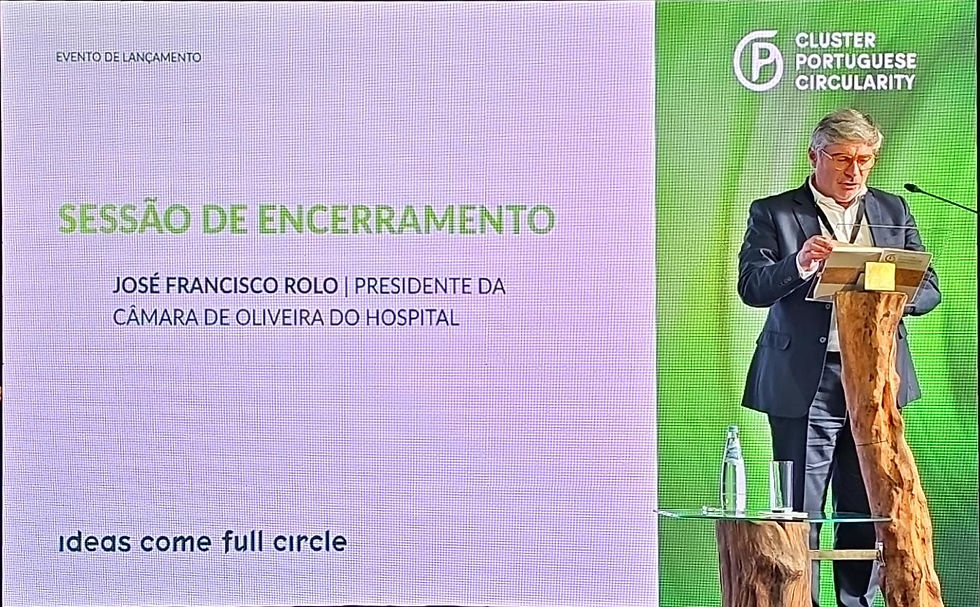
The closing session, led by José Francisco Rolo, reinforced the local and institutional commitment to the dynamic that the CPC aims to create. Among the dynamism that BLC3 brings to the municipality, he highlighted the work carried out on textile waste and the ambition consolidated 10 years after the distinction at Regiostars in various waste streams.
Digimatria and Garcia: Technology, Materials and Circularity (in construction) in Action
The possibilities for synergy between CPC and the work developed by Garcia (in construction) are revealed in two complementary areas. In the Digimatria project , the exploratory reconstruction of the digital twin of coatings and the predictive maintenance of industrial buildings allow for a significant extension of the service life of facades and roofs.

Meanwhile, at Garcia , the search for truly circular solutions is already materializing in concrete examples. The Circular Base , resulting from an industrial symbiosis between LIPOR and Harsco, demonstrates how downgraded waste products can give rise to a high-performance mechanical material, capable of competing with traditional solutions while incorporating principles of deep circularity.
Together, these approaches — extending the lifespan of materials and creating robust circular materials — reflect the potential of the construction sector to transform practices and accelerate the transition that CPC aims to drive.


Comments