
DIGIMATRIA at II Iberoconstruct: BIM and Construction Digitalisation
Opening of the Event and Institutional Messages
The first day of II Iberoconstruct — the Ibero-Brazilian Construction Meeting — brought together public decision-makers, companies and universities at the Universidad Politécnica de Madrid to discuss the transformation of the sector through industrialisation, technological innovation, sustainability and the evolution of contractual models.
In the opening session, with contributions from José Miguel Atienza, Miguel Ángel Carrillo, Fernando Santos and Humberto Varum, the need to strengthen project predictability, technical quality at delivery and transparency in public works processes became clear. These themes directly intersect with DIGIMATRIA’s ambition to use building digital twins to support technical commissioning, preventive maintenance — particularly of façades — and the early resolution of contractual disputes.

The Construction Sector in Spain — Julián Núñez
In his detailed intervention, Julián Núñez, President of SEOPAN, outlined the economic, environmental and regulatory pressures shaping the Spanish construction sector.
He welcomed the Spanish government’s forward-looking approach to promoting strategic infrastructure investments, integrated into a medium-term strategy, as well as the need to maintain existing assets.

The Construction Sector in Portugal and Brazil — Humberto Varum and Fernanda Fernandes Marchiori
The Iberian and Brazilian analysis included Humberto Varum and a presentation by Fernanda Fernandes Marchiori (Federal University of Santa Catarina and coordinator of the GESTCON group) on the challenges of public procurement in Brazil.
These contributions emphasised the importance of transparency and information consistency across borders — objectives that increasingly depend on shared digital models connecting planning, execution and supervision.
Roundtable: Industry Dynamics — moderated by Carlos Ursúa
Moderated by Carlos Ursúa, the panel brought together Concha Santos, Esther Ahijado, Fernanda Fernandes Marchiori and Jorge Moreira da Costa to debate industrialisation, governance and internationalisation.
The discussion underscored the importance of technical traceability and transparency in decision-making, principles aligned with the use of digital twins as living repositories of construction information and common references in acceptance and technical audit processes.
Innovation in the Construction Industry — Carlos Martínez Bertrand
Carlos Martínez Bertrand, Director of the Construction Technology Platform, addressed strategies to accelerate innovation adoption across the sector.
He highlighted digital experimentation and pilot projects as essential drivers for connecting research and practice, particularly in areas such as site monitoring, data integration and advanced planning systems.

Industrialisation and Robotics: 3D Modular Construction — Rui Garcia
In his presentation, Rui Garcia described the strategy of Garcia, Garcia S.A. through the AMB brand and the growing use of prefabricated bathrooms in the residential market, highlighting the Hines project.

The discussion on quality control, construction interfaces and technical validation at handover emphasised the importance of digital systems capable of documenting compliance and non-compliance during commissioning — an area where DIGIMATRIA can play a relevant role by structuring technical evidence linked to the building’s digital model.
Communicating Sustainability: Digital Product Passports — Pedro Mêda
Pedro Mêda (University of Porto / ICS) presented the concept of digital material passports as tools for documenting performance, circularity and environmental impact.
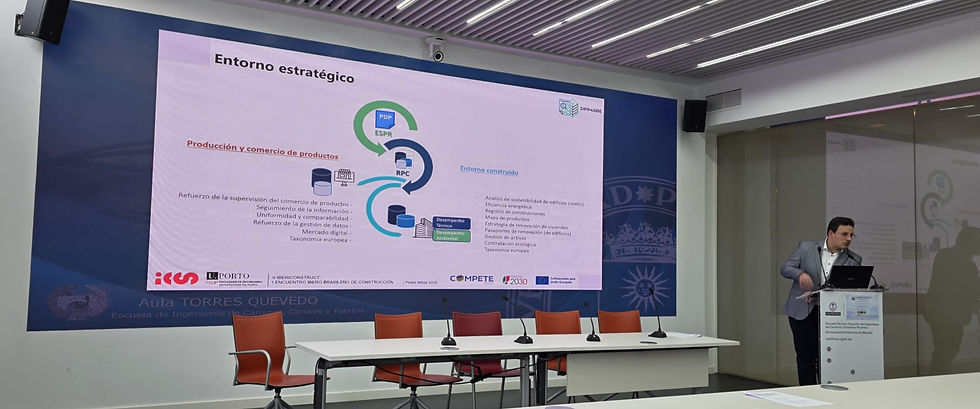
Integrating this information into a building’s digital twin is a natural step for DIGIMATRIA, enabling façade materials and construction systems to be linked to preventive maintenance plans, durability assessments and technical reports supporting asset management.
New Materials — Jaime Gálvez
Professor Jaime Gálvez (UPM) addressed emerging solutions and the need to monitor their real-world behaviour over time.
He highlighted the development of solutions designed to counteract concrete degradation caused by external agents such as carbonation and reinforcement corrosion, while meeting carbon footprint reduction targets.

BIM and Digital Twins — Marcos García
In the session dedicated to BIM, Marcos García highlighted the evolution toward large-scale digital twins capable of representing entire projects at very high levels of detail.
Examples such as Madrid’s M-30 ring road were presented, featuring more than 200,000 interconnected objects integrating geometry, planning and maintenance data. This approach aligns with DIGIMATRIA’s ambition to transform BIM models into living platforms supporting commissioning, building operation and technical management throughout the asset lifecycle.

Roundtable: The Future of Construction — moderated by Tiago Teixeira Martins
Moderated by Tiago Teixeira Martins, the panel included Hipólito Sousa, Francisco Reis (CEO of BIMMS), Gómez Hermoso (UPM Innovación Caminos), Antonio Gómez (CDTI) and Antonio Ramírez (Director of Innovation at Sacyr).
The debate reinforced the importance of interoperability, innovation funding, cross-cutting digital platforms and the sector’s attractiveness to new talent.

Conclusion
Day 29 of II Iberoconstruct demonstrated that industrialisation, sustainability and digitalisation are increasingly interconnected.
Sessions on modular construction, BIM, digital product passports and governance converged on the need for reliable data and integrated digital models throughout the entire asset lifecycle.
It is within this context that DIGIMATRIA positions itself: using building digital twins to anticipate pathologies, support preventive façade maintenance, strengthen commissioning processes and provide a solid technical foundation for contractual management and dispute resolution.


Comments